

Engineers will be able to train physical agents in the same manner that they do digital ones, according to the promise of physical AI.
While an entire business is emerging around monitoring factory lines and using gig workers to teach deep learning models to control robots, corporations must construct mock-up warehouses to test their equipment.
Another possibility is simulation, which might give roboticists the data and workspaces they need to carry out this work in a scalable manner by creating intricate virtual duplicates of real-world settings.
The goal of Antioch, a business that creates simulation tools for robot makers, is to bridge what the industry refers to as the “sim-to-real gap,” which is the difficulty of creating virtual environments that are realistic enough for robots trained in them to function dependably in the real world.
Antioch CEO and cofounder Harry Mellsop said:
“How can we do the best possible job reducing that gap, to make simulation feel just like the real world from the perspective of your autonomous system?”
In order to achieve this, the company said that it has raised a $8.5 million seed round, valued at $60 million, with participation from MaC Venture Capital, Abstract, Box Group, and Icehouse Ventures in addition to venture firms A* and Category Ventures.
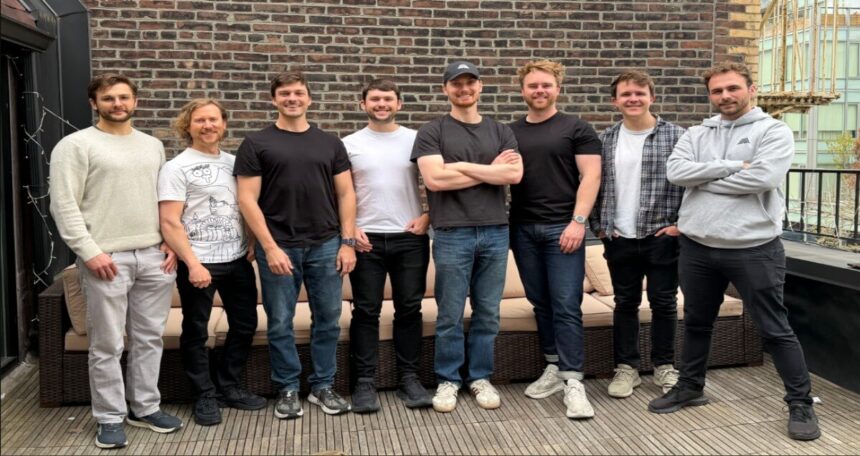
In May of last year, Mellsop and four cofounders launched the New York-based business. He founded Transpose, a security and intelligence firm, with the assistance of two other founders, Michael Calvey and Alex Langshur, and sold it to Chainalysis for an unknown sum. Collin Schlager and Colton Swingle, the other two, were formerly employed at Google DeepMind and Meta Reality Labs, respectively.
The core of the work being done by many large autonomy firms is the need for improved simulation. For instance, Waymo tests and assesses its driving model in the self-driving car arena using Google DeepMind’s world model. Theoretically, this method will reduce the amount of data needed to deploy Waymo vehicles in new locations, which is a crucial expense in advancing autonomous vehicle technology.
It could be argued that developing a self-driving car requires a different set of abilities than building and testing those models for robots, and Antioch aims to provide the platform that addresses that issue for startups that lack the funding to accomplish it all themselves. Additionally, those smaller businesses lack the resources to construct actual testing facilities or put sensor-equipped vehicles through a few million miles.
Mellsop said:
“The vast majority of the industry doesn’t use simulation whatsoever, and I think we’re now just really understanding clearly that we need to move faster”.
Executives at Antioch contrast their offering with the well-known AI-powered software development tool Cursor. With Antioch, robot builders can create several virtual versions of their hardware and link them to simulated sensors that replicate the data that the robot’s software would encounter in the real environment. These environments enable developers to create new training data, carry out reinforcement learning, and test edge situations.
If, that is, the fidelity of the simulation is great enough. The difficulty here is ensuring that the simulation’s physics is accurate so that nothing goes wrong when the model is used to control a real machine. The company creates domain-specific libraries to make models created by Nvidia, World Labs, and others user-friendly. Executives claim that working with a variety of clients provides Antioch with a depth of context for improving its simulations that no single physical AI business could match on its own.
Çağla Kaymaz, a partner at Category Ventures, said that:
“What happened with software engineering and LLMs is just starting to happen with physical AI. We do a lot of work on dev tools, and we love that vertical, but the challenges are different. With software, you can have these bad coding tools, and the risk is generally pretty contained to the digital world. In the physical world, the stakes are much higher.”
These days, Antioch is mostly focused on sensor and perception systems, which make up the majority of the requirements for automated vehicles and trucks, agricultural and construction equipment, and aerial drones. The goal of using physical AI to enable generalised robots to do human functions is still a long way off. Although Antioch primarily pitches to startups, some of its initial partnerships have been with large international corporations that have already made significant investments in robots.
Adrian Macneil is well-versed in this field. He developed the data infrastructure for the self-driving startup Cruise while serving as an executive there. In 2021, he started Foxglove, a business that provides physical AI startups with similar data pipelines. Macneil is an angel investor supporting Antioch.
On Wednesday,in San Francisco, at a AI conference he said that:
“Simulation is really important when you’re trying to build a safety case or dealing with very high-accuracy tasks. It’s not possible to drive enough miles in the real world.”
Mellsop said that:
“We genuinely all think that anyone building an autonomous system for the real world is going to do so in software primarily in two to three years. It’s the first time you can have autonomous agents iterate on a physical autonomy system, and actually close the feedback loop.”
Experiments have already been conducted in this area. Antioch’s platform is being used by David Mayo, a researcher at MIT’s Computer Science and Artificial Intelligence Laboratory, to assess LLMs. In one experiment, Mayo uses Antioch’s simulator to test robots designed by AI models. In simulated competitions, such as pushing a competing bot off a platform, it can even pit the models against one another. Providing a realistic sandbox for the LLMs could assist create a new benchmarking paradigm.
However, more effort needs to be done to bridge the gap between digital models and the real world before a world of AI engineers emerges. If it can be accomplished, developers will be able to build the kind of data flywheel that Macneil thinks is essential to the success of industry leaders like Waymo, where engineers are growing more certain that the model of the following month will be more capable than the previous one.
Other businesses will need to either purchase or develop those tools if they wish to duplicate that accomplishment.