





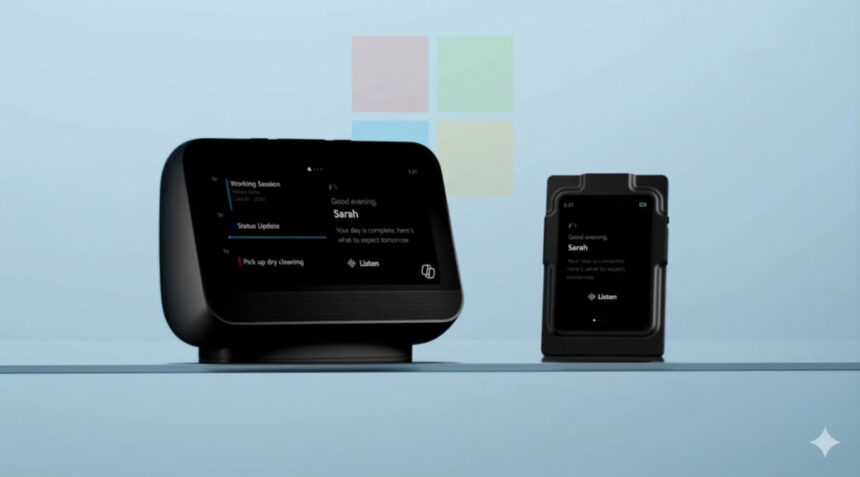
Microsoft is developing a wearable devices that uses artificial intelligence (AI). The company showcased two prototype solutions it developed for people who regularly use AI tools in their work at its annual conference for technology developers. One gadget is a tiny, portable cube designed for a desk that has a touch and voice-activated screen. The other was “a wearable access badge,” according to Microsoft executive Steven Bathiche, that would be worn around the neck or on a belt loop to provide instant access to AI-driven tasks.
Current pilots “will inform how these form factors can be built” in the future, according to Microsoft, which did not specify when it would release any of the devices. Microsoft CEO Satya Nadella called these wearable devices a “new form factor” for technology. They are now in use by some hundreds of Microsoft employees. Microsoft has made previous attempts to get into wearable technology.
The company developed a wearable headgear called the Hololens, akin to Apple’s Vision Pro headsets or the Meta Quest. The US Army was even going to buy the hololens in a billion dollar contract. But after nearly a decade of development and ongoing issues during military testing, Microsoft announced in 2024 that it would stop producing Hololens. Google is also taking another shot at wearables, announcing recently it would try again with “smart glasses” over a decade after its infamous Google Glass failure.
In a video showing off Microsoft’s AI-powered access badge and desktop device — part of what Nadella called Project Solara — people performing mostly office tasks were tapping the displays of both devices to view and interact with work being done by AI agents. Basically, agents are AI bots that do work in a somewhat autonomous way.
For example, technology workers often use such agents to help them write software code. Major tech leaders have frequently highlighted the development of this type of AI support in a recent wave of layoffs that have affected thousands of jobs.
A person could communicate with their AI agents outside of a laptop or desktop computer by connecting the desktop device and Microsoft’s badge to different Microsoft programmes and PCs. Bathiche stated that although the access badge is intended to be worn, it “is lightweight and designed for agent interactions on the go.”
At one time in the recorded footage, Nadella was seen wearing the access badge on a chain around his neck, just like people who enter office buildings must wear identification cards.Additionally, the badge has a tiny camera.Bathiche used his fingerprint to activate the wearable badge during his demonstration, directed it at the conference audience, and instructed it to snap some photos of the throng and email them to him for inspection.
He said it did. According to Bathiche, the camera enables agents “to better understand and help take action on the environment around them,” according to a blog post on the devices. When, why, and how cameras on other AI-focused devices—like Meta’s AI eyewear, for example—record and store footage have been the subject of considerable examination.














.%20The%20company%20showcased%20two%20prototype%20solutions%20it%20developed.)