

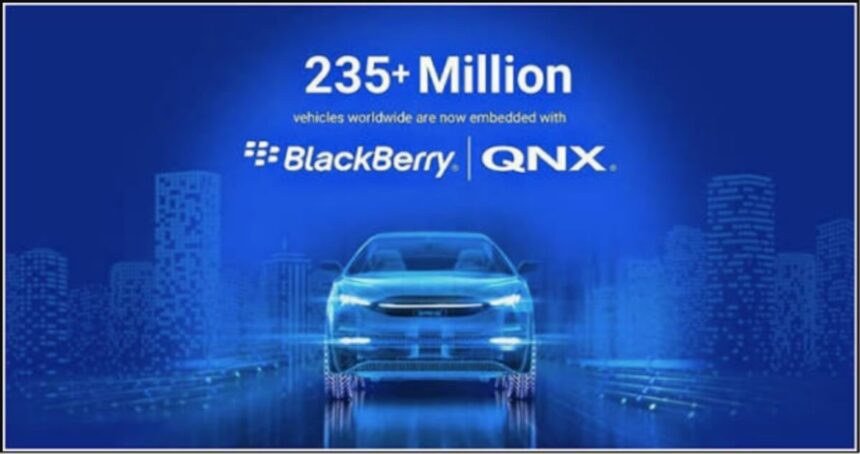
AI thesis of Blackberry is founded on QNX, the embedded OS that powers safety-critical systems in 275 million vehicles globally. Now, the company is focused on embedded operating systems, software and cybersecurity, not cellphones.
Some investors are comparing it to a stock market that has already moved a lot. The S&P 500 has gained 27% in the past year while the BB stock has gained 156%. BlackBerry has an average price target of $4.18, suggesting a 59% drop, with eight analysts covering the stock.
BlackBerry QNX
BlackBerry ditched smartphones and rebuilt itself around software, with QNX being the closest thing to its current AI story. The company’s pitch is about software being everywhere in cars, not about a dead consumer handset company.
This transition brings the discussion to a measurable asset, QNX runs safety critical systems in 275 million vehicles worldwide. Once the company’s biggest source of value was phone sales, but now it’s software embedded in other manufacturers’ products.
BlackBerry analysts
That argument has not been fully accepted by the broader market. BlackBerry is covered by eight analysts, with six rating it a Hold, one a Buy and one a Sell.
The discrepancy between the stock’s recent performance and average price target provides a tough question for investors in BlackBerry: Will QNX offer enough growth from its installed base to justify the move from hardware to software? Analysts are divided, which indicates that the market has not yet reached a consensus.
AI and the necessity for Nokia
That provides Nokia with the counter to position BlackBerry. In 2014 Nokia sold its handset division to Microsoft and has since re-invented itself as a telecom infrastructure company. It also benefitted from the increasing demand for AI networking, optical infrastructure and AI-RAN technologies.
Northland maintained its Outperform rating and increased its price target for Nokia on Wednesday from $13 to $20. According to Northland, recent remarks made by Nvidia CEO Jensen Huang fueled optimism in AI infrastructure stocks and highlighted Alphabet’s capital spending commitments and HPE’s strong demand for AI data centers.
BlackBerry’s present AI concept does not include that type of demand readout. Compared to Nokia’s AI-infrastructure exposure, its case flows through QNX in 275 million vehicles, a massive footprint that offers the firm size but also ties the story to a tighter lane.
John Wall, president of QNX said:
“Automakers rely on QNX because we deliver what matters most: safety, security, and proven reliability. As software becomes the backbone of modern mobility, QNX will continue to expand its footprint, powering the next generation of connected and autonomous vehicles.”
The practical reading for investors is simple: BlackBerry’s AI case depends on its embedded software base’s ability to continue advancing the business. The market is requesting execution rather than merely a well-known name because the stock has already moved much and the analyst target is still pointing lower.